

Woven works by Jaron Smedes van den Berg

by admin
As a part of our ongoing “what’s on your loom” series, we showcase the works of fiber artist Jaron Smedes van den Berg. After graduating as a cultural anthropologist, he found himself drawn to a more artistic approach to research, and is currently pursuing Fine Arts and Design at the Academy Minerva in The Netherlands. Jaron tells us about his works…
Right now, I am working on several pieces that resist digitization. As Western visual culture is a digital culture, all visual art is turned into mere information or data – a consumable entity. Every visual artwork can be transformed into a digital image that can then be consumed by the masses. Don’t get me wrong: I think there can be something quite emancipatory about that, but that’s only the case if it transcends mere consumption. If not, it simply renders us peons in our consumer-capitalist economies.
Recently, I found myself inspired by materials that are naturally good at resisting digitization, such as mother-of-pearl and white damask linen. The visual characteristics of these materials depend on the viewing angle, which makes them impossible to fully render on our modern monitors. By exploring visual forms that resist digitization, I try to challenge the dominant consumerist narrative in Western media. I won’t share the results of that research just yet, as they will soon be part of my graduation show in Groningen (NL) in early July.
In September last year, I made the Self-Disorganizing Tapestry, which addresses the relationship between digital and analog manifestations of order and chaos. I do not (yet) consider myself a weaver, but during my time at Cre-Actief in Bontebok, I was fortunate to have the opportunity to explore the possibilities of the TC2 for my practice. This tapestry was the result of that exploration.
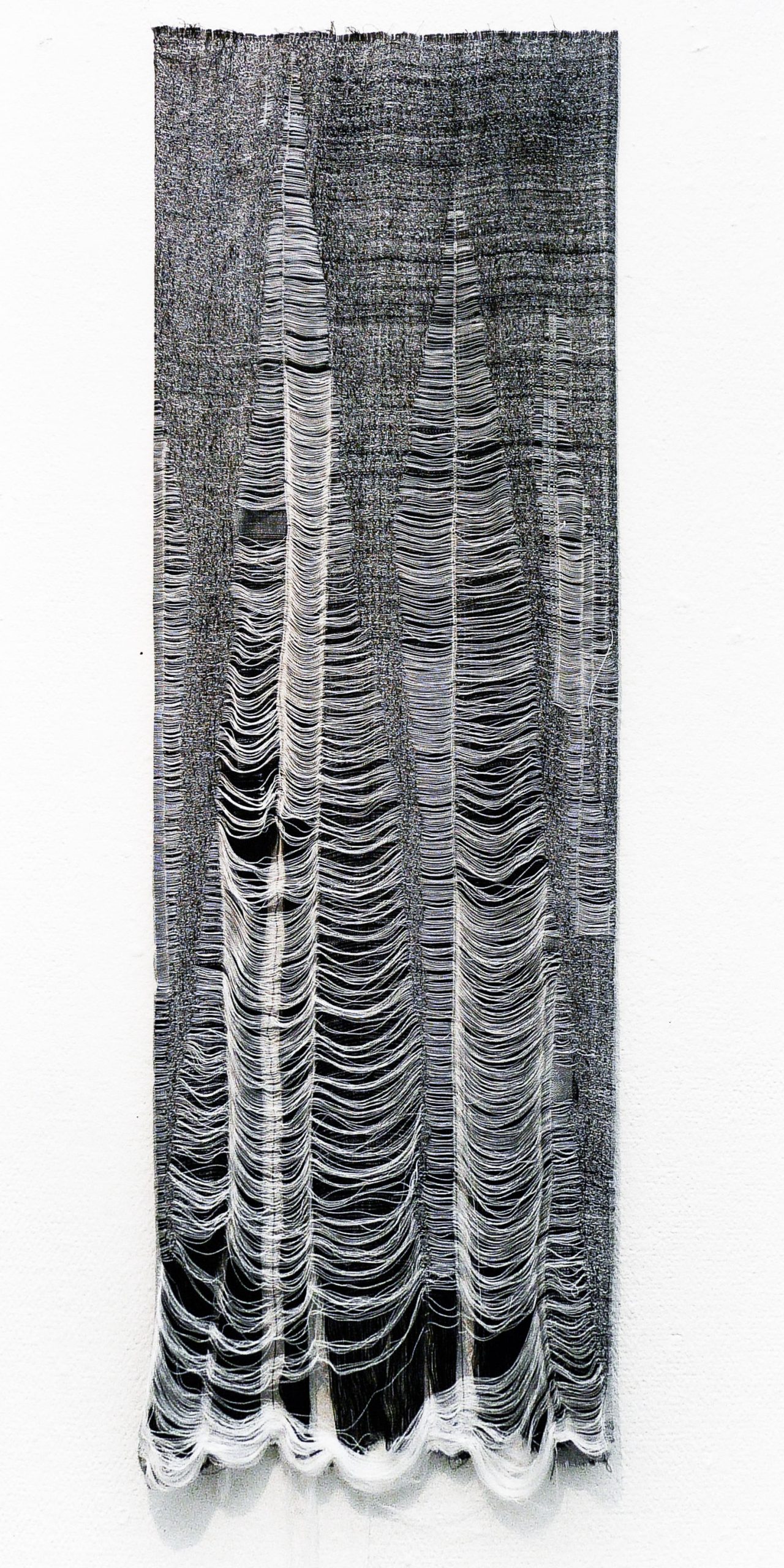
The Self-Disorganizing Tapestry was designed using a self-organizing algorithm I accidentally discovered some time ago. At the top, the tapestry starts with a line of random black and white pixels. As the algorithm progresses downward (not unlike Wolfram’s elementary cellular automata) the design starts to organize itself into horizontal lines.
In its digital form, we would call these horizontal lines orderly. As a tapestry, however, this self-organized order causes the fabric to unravel toward the bottom. The tapestry is thus held together by chaos; the social constructs of order and disorder here prove to be no farther apart than a single translation.
After a first trial on a 70cm wide TC2, the algorithm was slightly adjusted to accommodate for weavability. Then, the tapestry was woven on a 140cm wide TC2 with a blend of black-and-white cotton & Tencel.
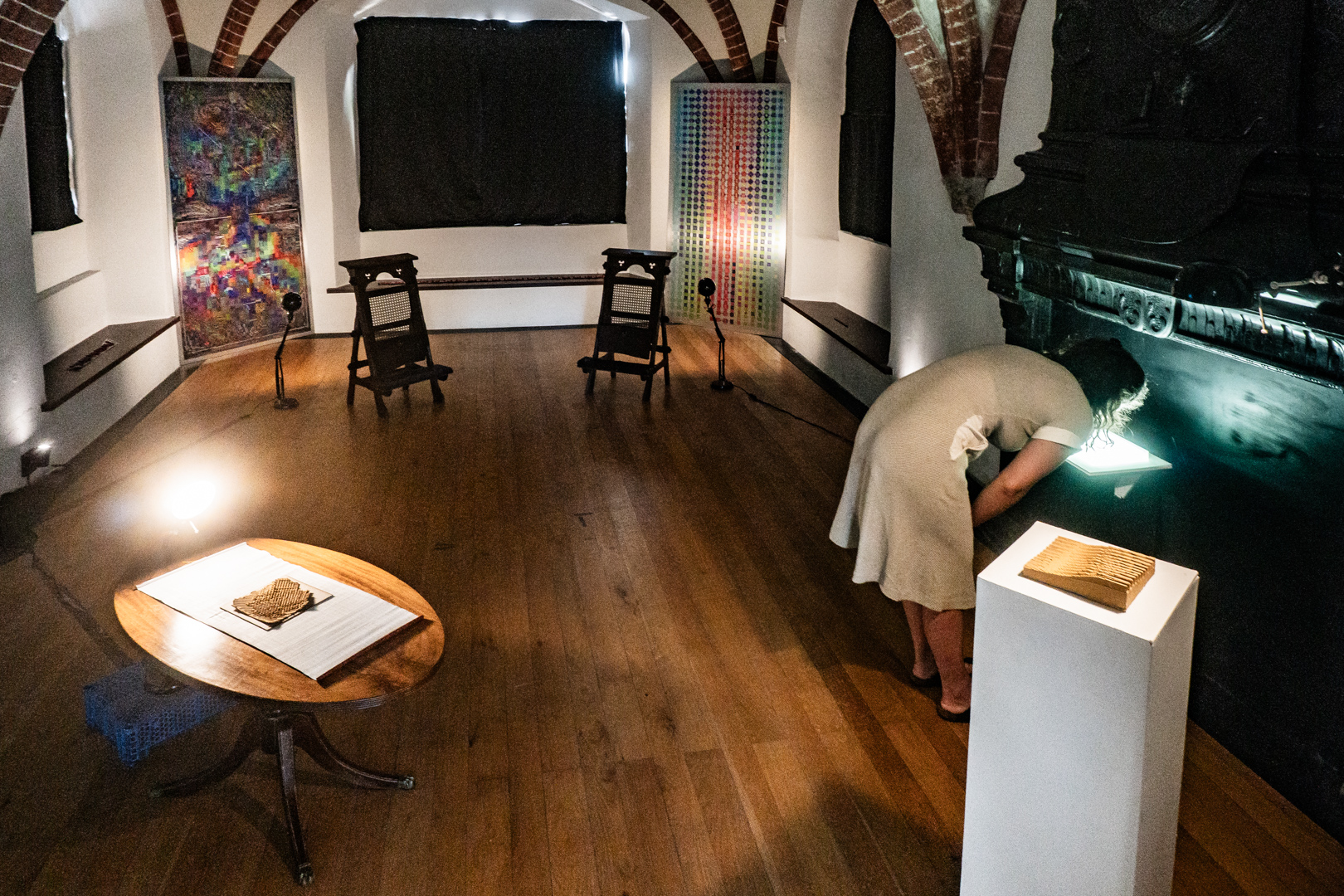
Below are pictures from my solo exhibition Artefacts, at Gallery Akerk in Groningen, The Netherlands. Artefacts are defined both as culturally significant objects and as undesired side effects of (digital) processes of creation. These two seemingly contradictory definitions are intimately connected, for they bring each other into existence – as all opposites do. Since nothing can meaningfully describe itself, everything exists by virtue of its equal and opposite counterpart. We therefore need these artefacts, these undesired elements to make meaning of the world. Paying thorough attention to what is usually undesired, we might better understand how we give meaning to the realities we inhabit and how we constantly produce these ourselves.
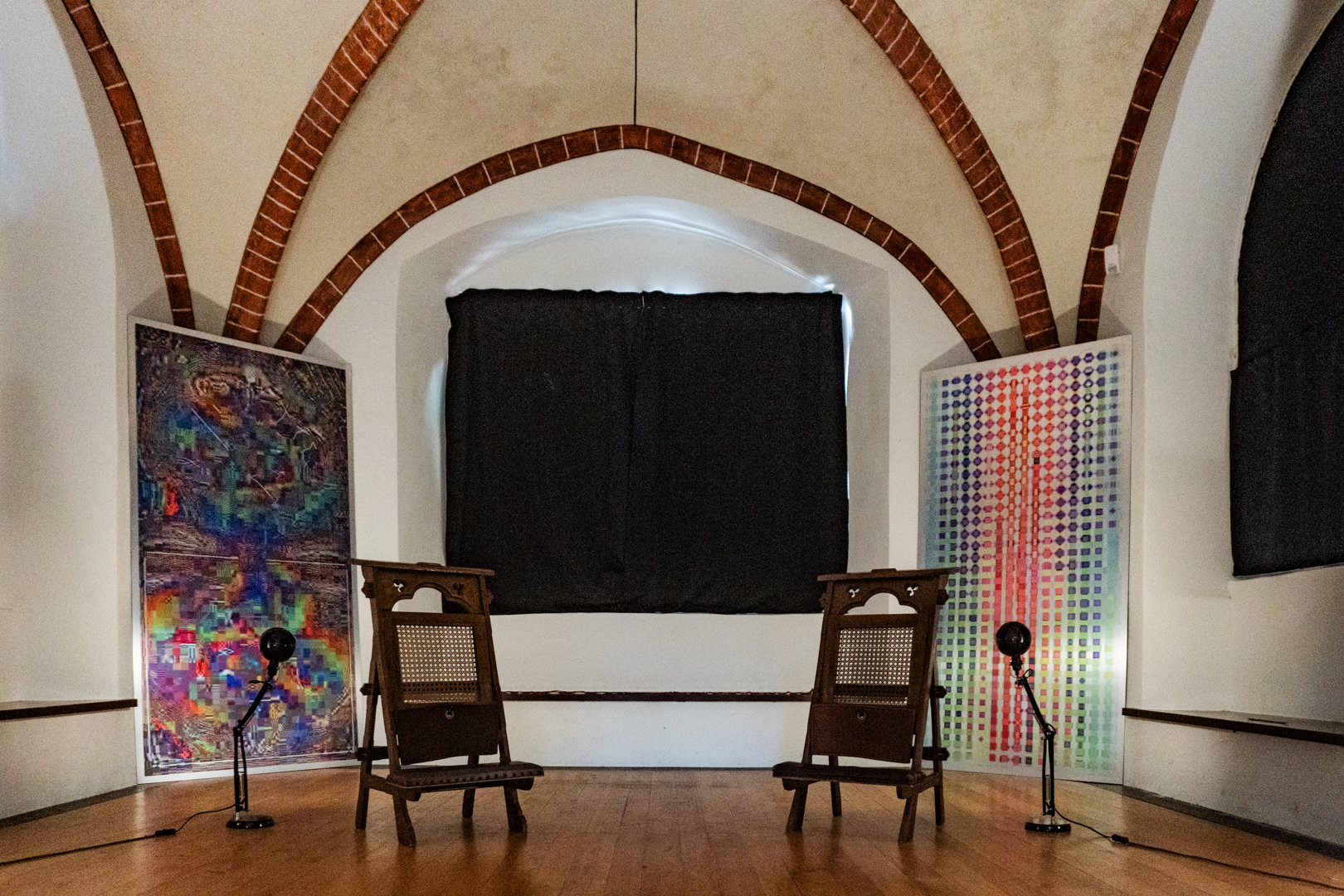
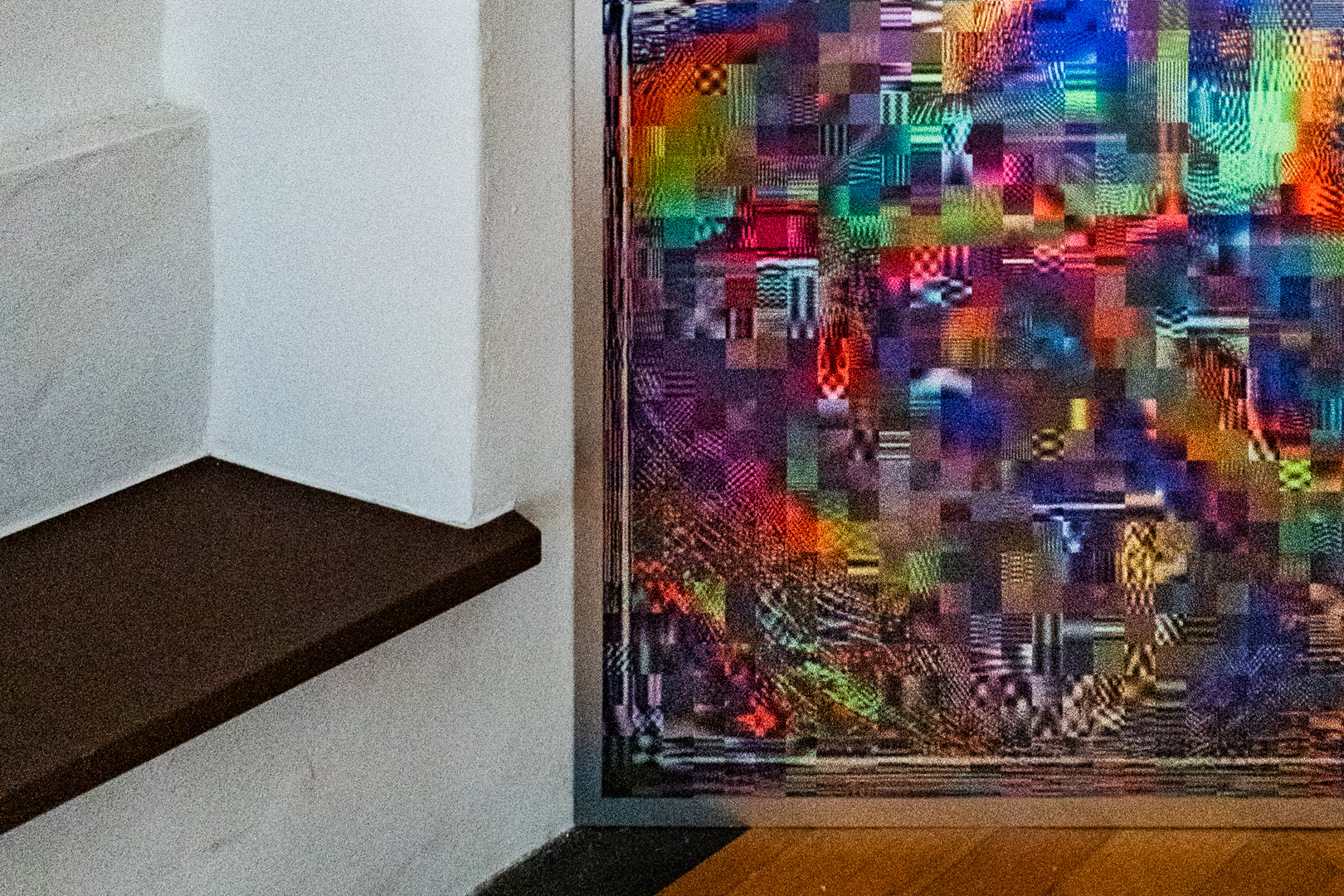
The pictures below are from the Anti-matter of Meaning exhibition at RESO Gallery in Groningen, The Netherlands (curated @basakeylulcakmak & @zsofironai). The exhibit revolves around the untranslatable, and features my Porcelain Record.
-
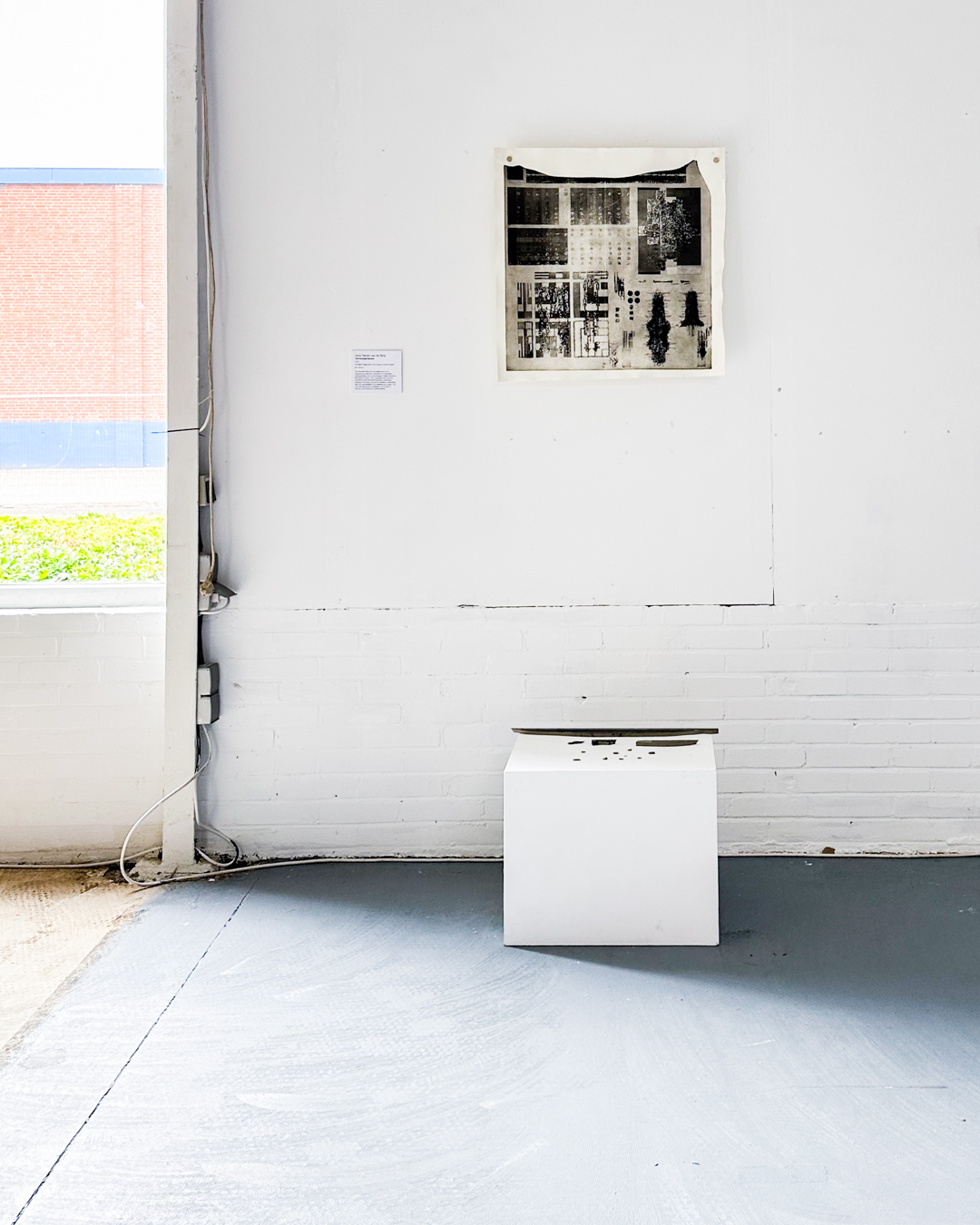
- The Porcelain Record, exhibited at anti-matter of meaning
-
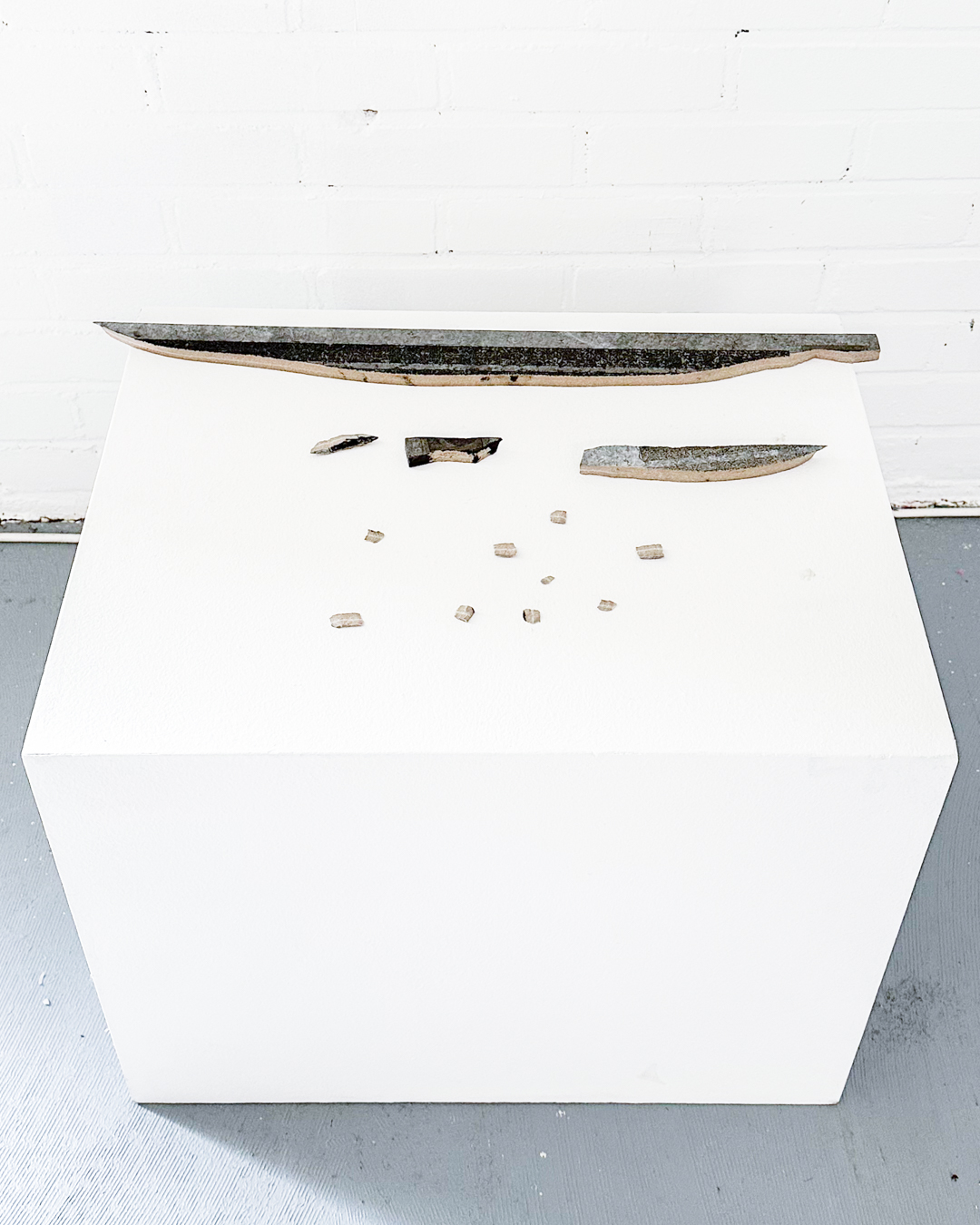
- Porcelain shards, part of the Porcelain Record
About…
Jaron Smedes van den Berg’s (1996) practice revolves around the metaphysics of digitality. Unsatisfied with culturally dominant, restrictive dichotomies, he opts for a non-dual approach to digitality. Rather than viewing the analog world as separate from the digital, he regards the two as polarities: opposites intimately connected.
By engaging with a wide range of machine-based techniques – including pen plotting, clay printing, laser cutting, and weaving – and exploring their outermost limits, he traces the edges of our digital surroundings. The works that result from these explorations function as visual essays or meditations examining analog manifestations of digital processes.
Links…
Recommended Posts
Third TC2 Trainers’ Meet at Digital Weaving Norway!
September 10, 2026
Handwoven book cloth by LMRM Chicago
March 13, 2026
Woven works by Raisa Kabir…
March 10, 2026